
The Song of the Lord · Prasthanatrayi · c. 400 BCE–200 CE
The Bhagavad Gita
On the field of battle, between two armies ready to destroy each other, the Lord of the Universe spoke — and changed the world forever.
Overview
The Most Beloved Text India Ever Produced
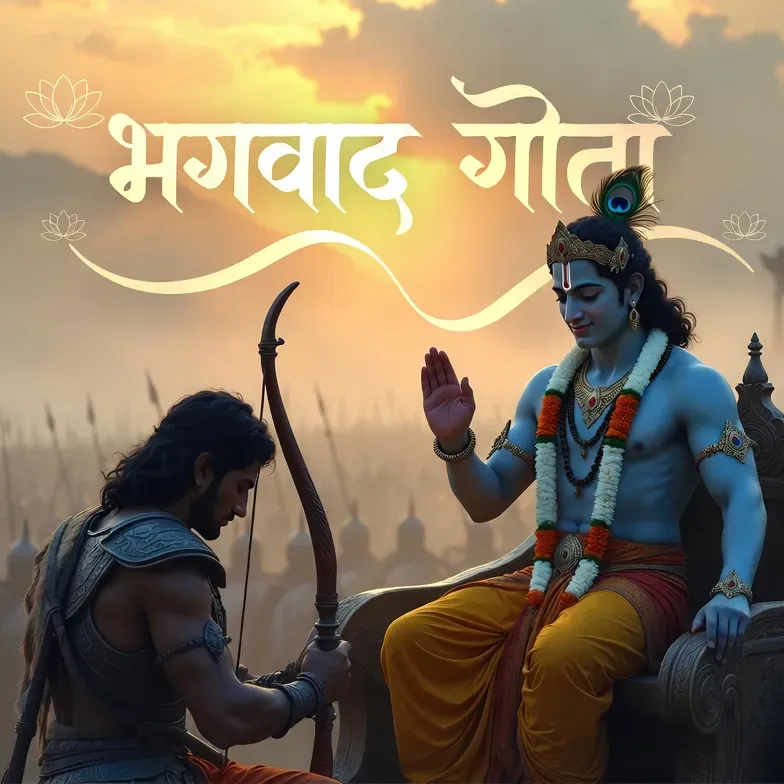
Embedded within the sixth book of the Mahabharata, the Bhagavad Gita — literally "The Song of the Blessed One" — is a dialogue of 700 verses in eighteen chapters between the warrior-prince Arjuna and his charioteer, the divine Krishna, on the battlefield of Kurukshetra moments before the start of a catastrophic civil war. Arjuna, faced with the prospect of killing his own teachers, cousins, and beloved kinsmen on the opposing side, is overwhelmed by grief and moral crisis and refuses to fight. Krishna's response to this crisis of conscience constitutes one of the most comprehensive philosophical and spiritual teachings ever addressed to a human being — one that covers the nature of the self, the structure of the cosmos, the proper basis of action, the paths to liberation, and the ultimate nature of the Divine.
The Gita is one of the most translated texts in the world — rendered into virtually every language and commented upon by some of the greatest minds in history, from Adi Shankaracharya in the eighth century to Lokmanya Tilak and Mahatma Gandhi in the twentieth. Gandhi called it his "spiritual dictionary" and returned to it every time he faced a difficult decision. Robert Oppenheimer quoted it in English and Sanskrit upon witnessing the first atomic explosion. Its capacity to speak to the human condition across cultures and centuries is unique among the world's spiritual texts.
Core Teachings
Three Paths, One Destination
The Gita's philosophical architecture organises the path to liberation into three principal approaches — three yogas that correspond to the three primary human faculties of action, knowledge, and love. Karma Yoga (the yoga of action) teaches that liberation is not achieved by abandoning action but by performing it without attachment to results — dedicating every deed as an offering to the Divine and releasing the fruit entirely. Jnana Yoga (the yoga of knowledge) guides the intellect toward the direct discrimination between the eternal self (Atman) and the perishable body-mind complex — recognising that what one truly is has never been born and can never die. Bhakti Yoga (the yoga of devotion) — which Krishna describes as the highest path in the Gita's later chapters — offers the grace of the Lord as a direct vehicle of liberation: surrender to the Divine completely, love the Lord with undivided heart, and the Lord himself carries the devotee across all obstacles.
The famous teaching of the second chapter — that the self is eternal, unborn, undying, and beyond the reach of weapons, fire, water, or wind — is one of the most direct and powerful statements of the soul's indestructible nature in any scripture. And the eleventh chapter, in which Krishna reveals his cosmic form (Vishwaroopa) to the awe-struck Arjuna, is one of the most extraordinary passages of visionary literature in any tradition — an attempt to convey in language the experience of perceiving the entire universe as a single, simultaneous, living divine presence.
Structure & Significance
Eighteen Chapters, One Complete Vision
The Gita's eighteen chapters move from the immediate crisis of Arjuna's grief (Chapter 1) through progressively deeper philosophical territory — the nature of the self and the imperishable, the practice of yoga, the qualities of the wise, the nature of the Divine, the distinction between the sacred and the profane, the three gunas (qualities of nature), the field and the knower of the field — before arriving in the final chapters at a teaching on the supreme devotion that is available to every human being regardless of birth, gender, caste, or spiritual attainment. The final verse of the Gita, spoken by the narrator Sanjaya, expresses a sense of wonder and certitude: "Wherever there is Krishna, the master of Yoga, and wherever there is Arjuna, the archer, there will be unending prosperity, victory, glory, and righteousness — this is my conviction."
Key Facts
At a Glance
Verses
700 shlokas in 18 chapters (Adhyayas)
Setting
The battlefield of Kurukshetra, embedded in the Bhishma Parva of the Mahabharata
Speakers
Primarily Krishna (speaking 574 verses) and Arjuna; narrated by Sanjaya to the blind king Dhritarashtra
Three Paths
Karma Yoga (action), Jnana Yoga (knowledge), Bhakti Yoga (devotion)
Prasthanatrayi
One of three foundational texts of Vedanta, alongside the Upanishads and Brahma Sutras
Global Reach
Translated into over 75 languages; one of the most commented-upon texts in the world
Jai Shri Krishna
May the eternal song of the Gita continue to light the path of all who face the battlefield of their own inner Kurukshetra.