
The Rare Cosmic Seat of the Creator
Jagatpita Brahma Temple, Pushkar
Dating back to the 14th century, this legendary sanctuary stands on the edge of Pushkar Lake as the world’s most significant active center dedicated to Lord Brahma.
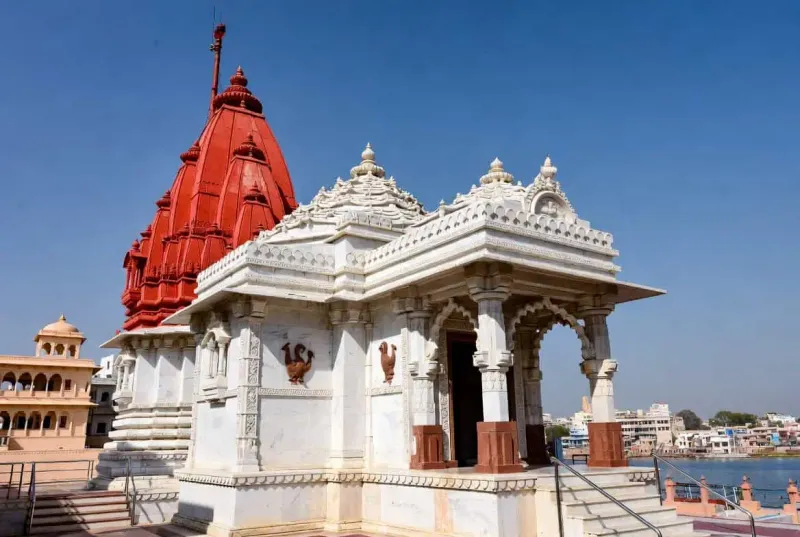
The Geographical Center of Vedic Lore
The **Jagatpita Brahma Temple** in Pushkar is an absolute anomaly in Hindu geography. While temples dedicated to Lord Shiva and Lord Vishnu number in the tens of thousands across the length of Bharat, operational shrines to Lord Brahma are exceptionally rare. This uniqueness traces back to complex Puranic narratives detailing a cosmic sacrifice performed by Brahma, which resulted in a curse from his consort, Devi Savitri, declaring that he would not be worshipped anywhere on Earth except in the valley of Pushkar.
The entire town of Pushkar is structurally designed around this metaphysical theme. The temple looks directly over the sacred Pushkar Lake, whose fifty-two ghats are seen as physical extensions of the divine lotus petals dropped by Brahma to pinpoint the exact geographic center of universal creation.
Architectural Form and Symbolism
The current structure dates to the 14th century, built over older foundations that were repeatedly preserved by dedicated ascetics. The temple is immediately recognizable by its striking bright red *shikhara* (spire), which rises boldly against the clear desert sky, and its distinct blue-painted stone pillars.
Atop the primary entrance arch sits the *Hamsa* (swan), the celestial vehicle of Lord Brahma that represents absolute discrimination, purity, and the capacity to extract spiritual truth from material existence. The interior pillared hall features a floor set with thousands of silver coins, placed by generations of families to mark their presence at the root source of time.
The Sanctum and the Four-Fold Vision
The *garbhagriha* (inner sanctum) houses a life-sized, four-faced (*chaumurthi*) manifestation of Lord Brahma. He sits cross-legged in a meditative stance, with each face oriented precisely toward a cardinal direction, symbolizing his universal awareness and the broadcast of the four original Vedas. The deity is accompanied by Gayatridevi on his left and is tended to exclusively by ascetics belonging to the Sanyasi lineage.
Pilgrimage Guide
Practical Navigation & Visitor Logistics
Timings
Open daily from 6:00 AM to 8:30 PM during summer months, with an afternoon closure between 1:30 PM and 3:00 PM for deity rest rituals.
Essential Custom
Traditional practice dictates that pilgrims must first perform a dynamic cleaning ritual or prayer at the Pushkar Lake ghats before climbing the temple steps.
Getting There
Ajmer Junction is the primary railway station (15 km away). A beautiful highway winds up through the Nag Pahar hills to link Ajmer directly with Pushkar.
Nearby Spiritual Circuits
Complete your sacred tour of Pushkar by visiting these essential local shrines:
- Savitri Temple: Located on the peak of Ratnagiri Hill, accessible via steps or a ropeway, offering panoramic views of the entire desert basin.
- Varaha Temple: The oldest temple structure in Pushkar, dedicated to the wild boar avatar of Lord Vishnu.
- Apteshwar Mahadev: A subterranean Shiva temple sitting adjacent to the Brahma shrine, showcasing historic low-set rock vaults.
Frequently Asked Questions
Why is Kartik Purnima significant here?
Kartik Purnima (October/November) marks the historic anniversary of Brahma’s cosmic sacrifice. It coincides with the world-famous Pushkar fair and brings millions for holy bathing rites.
Is photography permitted inside the temple?
No. Cameras, bags, and electronic equipment must be deposited securely in lockers outside the main entrance gate.