
Sacred Island Sanctuary · Primordial OM Configuration · Narmada River Axis
Shri Omkareshwar Jyotirlinga
An ancient riverine sanctuary shaped naturally like the primordial syllable OM by the winding currents of the sacred Narmada River, preserving the dual manifestations of Omkareshwar and Mamleshwar.
Divine Geography
The Island Shaped by the Primordial Sound
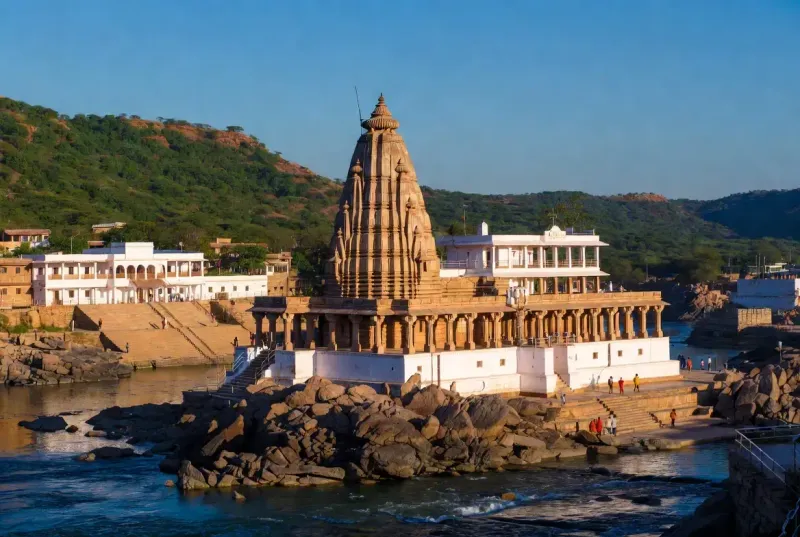
The natural world aligns with divine consciousness at Shri Omkareshwar. This sacred Jyotirlinga is uniquely situated on an island named Mandhata or Shivapuri, which rises from the pristine waters of the holy Narmada River. When viewed from above, the natural topography of the island, carved out by the splitting currents of the river, forms the exact shape of the sacred Sanskrit syllable ॐ (OM).
According to ancient Puranic history, King Mandhata of the Ikshvaku dynasty performed intense, unyielding penances here until Lord Shiva manifested as a radiant pillar of light to bless the land. The island itself is considered so sacred that walking its path—a 5-kilometer parikrama around the rugged, naturally dynamic hills—is an ancient practice undertaken by thousands of pilgrims every week.
The Split Divinity
Omkareshwar and Mamleshwar
The pilgrimage to this sacred geography is unique because the Jyotirlinga manifestation is split across two distinct structures on opposite banks of the river. On the holy island stands Omkareshwar, whose name means 'The Lord of the Om-sound'. On the southern mainland bank stands the historic Mamleshwar Temple (historically called Amareshwar).
Vedic tradition dictates that the two separate structures house a single, unified divine current. A complete pilgrimage to this site requires visiting both temples. The structure of Omkareshwar features a beautiful multi-layered style built with locally quarried soft sandstone, notable for its intricate, heavily carved columned halls (Mahamandapa) supported by massive, beautifully sculpted pillars.
Pilgrimage Guide
Visitor Information & Practical Details
Best Time to Visit
The post-monsoon and winter months from September to March are ideal, as the Narmada River flows with majestic volume and clarity under a pleasant sky.
Temple Timings
The inner sanctorum is accessible from 5:00 AM to 10:00 PM. Special afternoon bhog and evening dynamic Shringar aartis are beautiful highlights of the daily schedule.
The Narmada Crossings
Visitors can cross over to the sacred island via an impressive, newly built pedestrian suspension bridge or take traditional wooden boats across the river gorge.
Getting There
The nearest major railway intersection and domestic airport is located in Indore, roughly 70 kilometers away, connected by regular state buses and private taxis.
Om Namo Bhagavate Rudraya
May the sacred resonance of the Narmada island awaken the primordial truth of OM within your heart.