
Sacred Spaces of the Divine
Prominent Hindu Temples of India
Where stone becomes prayer and architecture becomes devotion — a journey through ten of India's most sacred and storied temples.
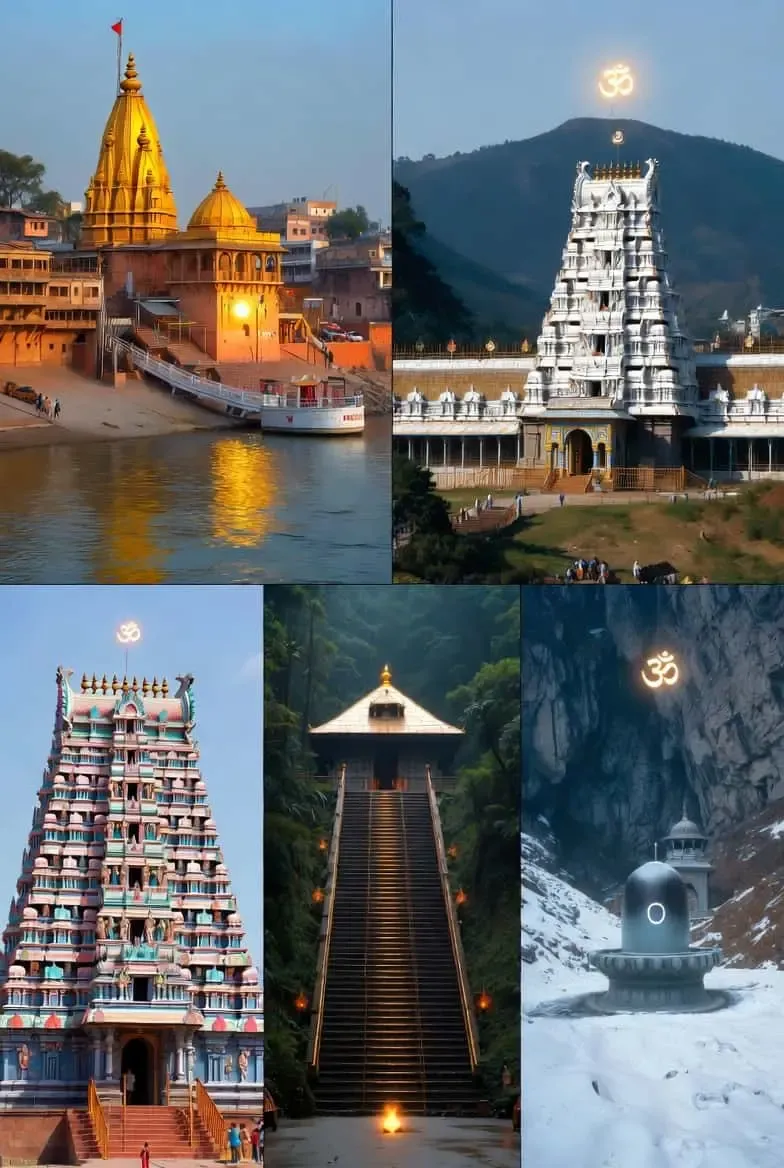
India is a land where the sacred is not confined to the pages of scripture but is woven into the very landscape. For millennia, its people have built temples — not merely as places of worship, but as monuments to the living presence of the Divine. These structures are cosmological statements in stone, wood, and gold, each one a universe unto itself, designed according to the ancient science of Vastu Shastra and consecrated through elaborate Vedic rituals that align the earthly with the eternal.
The ten temples presented here span the length and breadth of the subcontinent, from the Himalayan snowfields to the southern coastline, from the desert sands of Gujarat to the lush valleys of Jammu. Each carries its own mythology, its own architectural grandeur, and its own particular form of the sacred — yet all share a common thread: the unwavering conviction that the Divine is near, that it can be approached, and that in the act of approaching, the seeker is transformed.
Kashi Vishwanath Temple
Perched on the western bank of the sacred Ganga in the ancient city of Varanasi — which many consider the spiritual capital of the world — the Kashi Vishwanath Temple stands as one of the most venerated Jyotirlinga shrines in all of Hinduism. Dedicated to Lord Shiva in his aspect as Vishwanath, the Lord of the Universe, this temple draws millions of pilgrims each year who come to seek liberation, offer prayers, and bathe in the holy river below. According to ancient belief, Kashi itself is held in the hand of Shiva, and those who die within the sacred precincts of this city are whispered the Taraka mantra in their ear by Shiva himself, ensuring their liberation from the cycle of rebirth. The present temple, its towering shikhara crowned by a golden spire donated by Maharaja Ranjit Singh in the nineteenth century, has been destroyed and rebuilt multiple times through the centuries, yet its sanctity has remained undiminished through every age. To stand before the Vishwanath Jyotirlinga is, for countless Hindus, the deepest aspiration of a devout lifetime.
Explore Kashi VishwanathTirumala Venkateswara Temple
Rising above the seven sacred hills of Tirumala in the Eastern Ghats, the Venkateswara Temple — universally known as Tirupati Balaji — is the most visited place of pilgrimage in the entire world, welcoming an average of fifty to a hundred thousand devotees every single day. The presiding deity, Lord Venkateswara, is believed to be a living manifestation of Lord Vishnu who descended to the earth age to alleviate the suffering of humanity in the present era. The idol at the sanctum sanctorum is considered svayambhu — self-manifested — and is clothed, adorned, and fed with extraordinary care and devotion daily. The temple's enormous wealth, accumulated through centuries of royal patronage and the offerings of the devout, is channelled into vast charitable works spanning education, healthcare, and food distribution across the region. Pilgrims stand in queues that sometimes stretch for many hours, yet none leave feeling that the wait was too long — for a glimpse of Balaji's face, they say, is worth every step of the journey.
Explore Tirupati BalajiMeenakshi Amman Temple
In the heart of Madurai — a city older than most of the world's great capitals — the Meenakshi Amman Temple erupts from the landscape in a breathtaking cascade of colour and form. Its fourteen gopurams, or gateway towers, reach heights of up to fifty-two metres and are encrusted with thousands of individually sculpted figures from Hindu mythology, their colours blazing against the South Indian sky in shades of red, green, blue, and gold. The temple honours the divine marriage between Goddess Meenakshi — the fish-eyed queen said to be an incarnation of Parvati — and Lord Sundareswarar, a form of Shiva. Their celestial wedding is re-enacted each year during the grand Meenakshi Tirukalyanam festival, drawing vast multitudes to witness what devotees experience not as a historical event but as an eternally recurring cosmic reality. With its celebrated Hall of a Thousand Pillars, its sacred golden lotus tank, and its labyrinthine corridors that could house an entire village, the Meenakshi temple is not merely a place of worship but a living city of the sacred — a universe into which one steps and from which, inwardly, one never quite returns.
Explore Meenakshi AmmanSomnath Temple
Standing at the confluence of three sacred rivers — the Hiran, the Kapila, and the mythical Saraswati — at the very tip of the Saurashtra peninsula where they merge into the Arabian Sea, the Somnath Temple carries a weight of history that few structures anywhere in the world can equal. Regarded as the first and most exalted of the twelve Jyotirlingas — shrines where Shiva manifested as a pillar of infinite light — Somnath is simultaneously a symbol of extraordinary spiritual power and extraordinary resilience. Over the centuries it was attacked and demolished multiple times, yet each time the people of India came together to rebuild it, a testament to faith that cannot be broken by physical force. The present magnificent temple, consecrated in 1951 with the active involvement of Sardar Vallabhbhai Patel as one of independent India's first great acts of cultural restoration, stands where the land meets the ocean in a setting of raw, windswept beauty. To visit Somnath is to feel the full sweep of India's sacred history — its glory, its suffering, and its indestructible capacity for renewal.
Explore Somnath TempleKedarnath Temple
At an elevation of over thirty-six hundred metres in the Garhwal Himalayas, surrounded by snow-crowned peaks and the roaring Mandakini river, the Kedarnath Temple occupies one of the most dramatically sacred positions of any shrine on earth. It is one of the four sacred sites of the Char Dham pilgrimage circuit and is counted among the twelve Jyotirlingas. The shrine is believed to have been established by the Pandavas of the Mahabharata, and its current stone structure is attributed to Adi Shankaracharya in the eighth century — a philosopher-saint who, according to tradition, attained maha samadhi just behind the temple. Kedarnath is accessible only on foot — a trek of nearly twenty kilometres from the last motorable road — and is open to pilgrims only between May and November, after which the valley disappears beneath heavy snowfall and the deity is ceremonially moved to Ukhimath for the winter months. The sheer effort of reaching Kedarnath is itself regarded as an act of devotion, and those who make it to the ancient stone shrine often describe the experience as one of the most profound of their lives — a meeting not just with a deity but with the raw, silent heart of the Himalayas themselves.
Explore Kedarnath TempleJagannath Temple, Puri
Rising sixty-five metres above the coastal city of Puri in Odisha, the magnificent spire of the Jagannath Temple — visible for miles out to sea and a landmark for ancient sailors — has presided over this sacred town for close to a thousand years. The presiding deity, Lord Jagannath — the Lord of the Universe — is a unique and ancient form of Krishna whose iconography, with large circular eyes and limbless torso, is unlike any other representation in the Hindu tradition, pointing to roots that predate classical Sanskrit culture and reach into the tribal spiritual heritage of Odisha. The temple is one of the four sacred Dhams of India and is also celebrated for the Rath Yatra — the Chariot Festival — in which the massive wooden chariots bearing the idols of Jagannath, his brother Balabhadra, and sister Subhadra are pulled through the streets of Puri by hundreds of thousands of hands in one of the largest religious gatherings in the world. The temple's Mahaprasad — the cooked food offered to the deity and distributed to all — is regarded as supremely sacred, prepared in one of the world's largest temple kitchens and considered free from caste distinction, nourishing all who receive it equally.
Explore Jagannath TempleBrihadeeswarar Temple, Thanjavur
Built over a thousand years ago by the great Chola emperor Raja Raja I and consecrated in the year 1010 CE, the Brihadeeswarar Temple in Thanjavur stands as one of the supreme architectural achievements of the ancient world. A UNESCO World Heritage Site, it soars to a height of approximately sixty-six metres — making its towering vimana one of the tallest temple towers built in India at that time — and the massive capstone at its summit, estimated to weigh around eighty tonnes, was raised into position using an inclined ramp that stretched for several kilometres. The perfection of its proportions, the quality of its granite construction, the delicate beauty of its frescoes, and the mathematical sophistication underlying its design all point to a civilization operating at the heights of its creative and intellectual power. The shiva linga in the main sanctum is enormous — one of the largest in the world — and the Nandi bull that guards it is hewn from a single stone of great scale. To walk the corridors of the Brihadeeswarar Temple is to move through a universe of art, devotion, and ancient intelligence that continues to humble and astonish every visitor.
Explore Brihadeeswarar TempleRamanathaswamy Temple, Rameswaram
On the island of Rameswaram at the southern tip of India — separated from Sri Lanka by the narrow Palk Strait — the Ramanathaswamy Temple occupies a position of extraordinary sacred geography. It is one of the twelve Jyotirlingas and one of the four sacred Dhams, meaning it holds a place of honour at both ends of the great axis of Hindu pilgrimage that stretches from the Himalayas to the ocean. According to the sacred narrative of the Ramayana, it was here that Lord Rama worshipped Shiva to seek absolution after the battle of Lanka, and it was here that he constructed the legendary bridge of stones — Rama Setu — that allowed his army to cross to Sri Lanka. The temple's corridors are among the longest of any temple in the world, their magnificent colonnades stretching for over a kilometre in total length, creating a processional space of stately and solemn beauty. The temple also houses twenty-two sacred theerthams — wells of holy water — and pilgrims are required to bathe in each before entering the inner sanctum, a purificatory rite that takes on profound meaning in this place where ocean, island, legend, and devotion meet.
Explore Ramanathaswamy TempleVaishno Devi Temple
Nestled within the Trikuta Mountains of Jammu at an altitude of approximately fifty-one hundred feet, the Vaishno Devi shrine is one of the most beloved and heavily visited pilgrimage sites in all of India, drawing upwards of eight million devotees each year. The goddess Vaishno Devi — a manifestation of Adi Shakti, the primordial feminine energy of the cosmos — is enshrined not in a man-made idol but in three naturally occurring rock formations called pindis, situated within a holy cave that pilgrims enter in reverence and wonder. The cave itself, narrow and lit by the flickering of lamps, carries an atmosphere of extraordinary intimacy with the Divine. The journey to the shrine involves a trek of fourteen to fifteen kilometres through mountain terrain, undertaken day and night by pilgrims of all ages and physical abilities, many of them barefoot as a sign of devotion. There is a quality to the pilgrimage to Vaishno Devi — the mountain air, the crowd of fellow-seekers, the chanting that echoes across the valleys — that turns the physical climb into an unmistakable metaphor for the inner journey toward the Divine.
Explore Vaishno Devi TempleBadrinath Temple
Cradled between the towering Nar and Narayan mountain ranges at an altitude of over thirty-one hundred metres in the Garhwal Himalayas, Badrinath Temple is one of the holiest pilgrimage sites in Hinduism and the northernmost of the four sacred Dhams. The temple enshrines a black stone image of Lord Vishnu seated in yogic meditation — a form known as Badrinarayan — and is believed to be the very spot where Vishnu engaged in deep austerities, sheltered from the harsh Himalayan elements by the Badri tree, a wild berry known in this region from ancient times. The shrine is attributed in its present form to Adi Shankaracharya, the great philosopher-saint of the eighth century who is credited with reviving and organising the Char Dham pilgrimage circuit. Like Kedarnath, Badrinath is open only during the summer months, closing in November as the valley surrenders to winter. The Alaknanda river flows swiftly past the temple complex, its icy waters fed by glaciers above, and the thermal hot springs near the entrance allow pilgrims to bathe before entering the sanctum. In the silence of the surrounding mountains and the clarity of the Himalayan air, Badrinath communicates a sacred stillness that has drawn seekers from across India for well over a millennium.
Explore Badrinath TempleAyodhya Ram Mandir
Standing on the sacred banks of the Sarayu River in the ancient city of Ayodhya, the Ram Janma bhoomi Mandir marks the birthplace of Lord Ram, the seventh avatar of Vishnu. A masterpiece of traditional Maru-Gurjara architecture, this magnificent pink sandstone structure represents the culmination of centuries of devotion and a historic cultural renaissance. The temple is not just a place of worship but a symbol of 'Ram Rajya'—an ideal of righteous governance and moral living that has inspired Bharat for millennia.
Explore Ayodhya Ram MandirSuchindram Thanumalayan Temple
Located near the southernmost tip of Bharat in the Kanyakumari district, the Suchindram Thanumalayan Temple is a rare spiritual landmark where the energies of the Hindu Trinity—Brahma, Vishnu, and Shiva—are worshipped as a single, unified deity. The name 'Thanumalayan' itself serves as a profound theological bridge: 'Stanu' representing Shiva, 'Maal' representing Vishnu, and 'Ayan' representing Brahma. This 17th-century architectural marvel is dominated by a 134-foot-tall white gopuram that stands as a beacon of devotion against the sky. Beyond its unique iconography, the temple is world-renowned for its 'Alankara Mandapam,' which houses four massive musical pillars carved from single blocks of granite that resonate with melodic notes when tapped. With its colossal 18-foot monolith of Lord Hanuman and its sacred temple tank, Suchindram offers a unique perspective on the unity of the Divine, where ancient stone-craft and deep Vedic philosophy meet in silent harmony.
Explore Suchindram TempleGuruvayur Sree Krishna Temple
Revered as the 'Bhuloka Vaikuntha,' Guruvayur is a global center for Krishna consciousness. The temple is world-famous for its rigorous ritualistic purity and its deep historical link to the idol worshipped by the Lord himself in Dwarka. It stands as a living testament to Kerala's ancient spiritual pageantry and Vedic traditions.
Explore GuruvayurSabarimala Shri Ayyappa Temple
One of the world's largest annual pilgrimages, Sabarimala is a unique mountain sanctuary within the Western Ghats. It is renowned for its message of 'Tat Tvam Asi' (Thou Art That) and the rigorous 41-day penance that transcends all barriers of social status and caste. The journey to the 18 sacred steps is a profound experience of human endurance and faith.
Explore SabarimalaEach of these temples is a doorway — not merely a place to visit, but a threshold to cross. May every seeker who approaches them, whether in body or in spirit, find what they are truly looking for.